
You might remember that little pinch on your arm or a quick jab to the thigh as a child: A momentary sting followed by a cartoon band-aid and the promise of ice cream. Or perhaps, more recently, you joined the throngs of people eager to get their COVID-19 shots.
But have you ever paused to consider the wizardry responsible for these life-saving elixirs? If you are curious about the magic behind the needle, let’s venture into the captivating realm of vaccine technologies:

Kicking Off Vaccine Tech Back in the 70s
Before we dive into the latest and greatest, let’s hop into our time machine and revisit the 1790s. The smallpox disease was having a devastating party across the globe. Enter Edward Jenner, the original vaccine maestro, who observed that milkmaids who contracted cowpox (a less severe disease) did not get smallpox.
Using material from cowpox blisters, he inoculated a boy. And voilà! The boy was protected. This was the first glimpse of what we now call the live-attenuated vaccine. Essentially, this technique uses a live, weakened form of a virus to train our immune system.
The Traditional Heavyweights
- Live-attenuated vaccines (think measles or mumps) still utilize Jenner’s principle. They use a watered-down version of the virus. Something that trains our immune system without causing the disease.
- Inactivated vaccines (like polio) take the opposite approach. They use a killed version of the germ. These vaccines are like the reliable elder sibling: Not as flashy, but they have got your back.
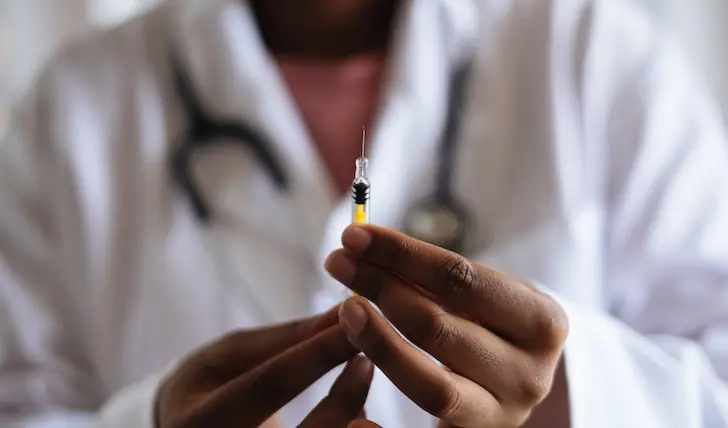
Nonetheless, they might need booster shots occasionally.
Modern mRNA and Viral Vectors
The COVID-19 pandemic pushed science into warp speed, resulting in the rise of two standout technologies:
mRNA vaccines (like Pfizer-BioNTech & Moderna)
In the simplest terms, think of mRNA as a temporary instruction manual. Instead of directly injecting the virus, these vaccines give our cells the recipe to produce a harmless piece of the virus, usually the spike protein.
Our immune system then spots this foreign element and remembers how to tackle it if the real virus comes knocking. However, this is not mRNA’s debut. Scientists have been studying them for decades.

Viral Vector Vaccines (Like Oxford-AstraZeneca)
These are like Trojan horses. They use a different virus as a delivery system, inserting a piece of the target virus’s genetic material inside. Once inside our cells, this genetic material produces a component of the target virus, priming our immune system for future encounters.
Parting Thoughts
No matter the technology, vaccines have a common goal: to train our immune system without making us sick. They provide a sneak peek of the enemy so that if we ever face the real deal, our body is ready, armed, and dangerous. While that little pinch might seem simple, there is a vast universe of innovation and wonder behind every droplet.
So, the next time you roll up your sleeve for a shot, take a moment to marvel at the history and science. And promise that courses through your veins. Remember, while the future of vaccine technology holds mysteries yet to be unraveled, the power to safeguard humanity remains at its heart.